
Lumiinox / Knowledge
Cutting and bending with the same partner: lower costs, fewer errors
How many times does a sheet metal project go through three different suppliers? One cuts, another bends, another welds and assembles. Each pass adds deadlines, transportation, costs, and risks of error. And when something goes wrong, the blame game begins: it was the cutting's fault, it was the bending's fault, it was the design's fault. At Lumiinox we follow the opposite path: cutting and bending at the same partner, within the same workshop, with a single team responsible from start to finish.
In this article we explain how this integrated flow works, why it reduces costs and errors so noticeably, and for what type of clients it makes the most difference. If you have already lost days coordinating suppliers or correcting parts that didn't fit, this text is for you.
The problem of the fragmented process
Let's start with the usual scenario. The customer sends the drawing to a cutting company, receives the parts, transports them to a bending workshop, waits for the bending, and then takes everything to the metal shop that will weld and assemble it. At each stage there is a queue, a transport, a new interlocutor interpreting the drawing.
Problems appear at the boundaries. The cutting was done without knowing how the piece would be bent, so the planning did not compensate for the bends: the final measurements come out wrong. The bending workshop received parts without the expected reference lines. The welder realizes that a clearance was not foreseen. Each correction is a new cycle of transport and waiting, and the initial deadline is no longer remembered.
The hidden cost of fragmentation: transport between suppliers · queues in each workshop · errors in interpreting the drawing · tolerances that add up · diluted responsibility when something goes wrong.
A continuous flow, from file to part
At Lumiinox, the process is different. It all starts with the technical drawing, analyzed by someone who knows both operations. The part's layout is calculated to anticipate the bends: radii, offsets, and sequence. The sheet is cut on our machine MAQFORT MCL3015OF fiber laser cutting, with precision on sheets up to 1500 × 3000 mm, and goes directly to the MAQFORT AP 30/125 T hydraulic press brake, where it takes shape with precise bends up to 1250 mm.
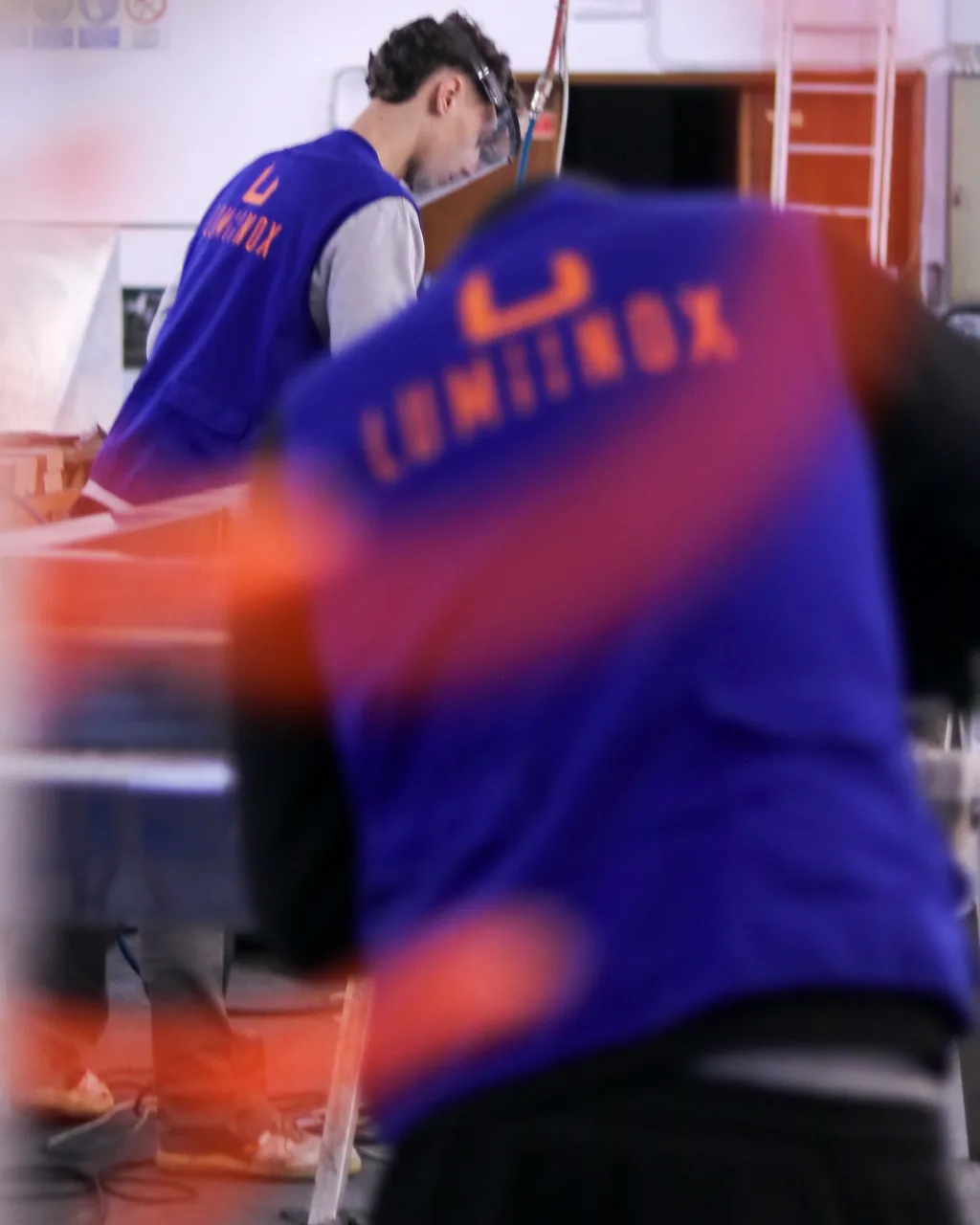
No intermediate transport, no waiting between suppliers, no reinterpretations of the drawing. The part that comes out of the laser is the same one that enters the press brake minutes later, and whoever bends it participated in the decision of how it was cut.
Fewer errors, because tolerances are considered together
The most important technical advantage of integrated flow is in tolerances. A bent part always has small variations: from the sheet, from the cut, from the springback of the material during bending. When each operation is done by a different company, each one works to its own tolerance and no one manages the sum. The result appears in the assembly: holes that do not align, tabs that do not touch, assemblies that need force to close.
When everything happens in the same workshop, the cutting design is already designed with bending in mind. The bending lines can be laser-engraved directly on the part. Holes near the bends receive calculated reliefs. And if the first piece in the series reveals a necessary adjustment, the file is corrected and the second one comes out right, without a week of emails between three companies.
How the design coordinates between the two operations
The technical secret of integration lies in how the design is handled. When we receive the final piece, the first step is flattening: unfolding the piece on the computer, calculating how much material each bend consumes. This value, the so-called bend loss, depends on the material, thickness, inner radius and bending method, and this is where many fragmented processes fail, because the cutter doesn't know which parameters the bender will use.
In our workshop, the press brake parameters feed into the cutting flattening. The die and punch that will be used determine the actual bend radius, and this radius goes into the calculation of the unfolded piece. The laser cuts the exact plan, engraves the bending lines when necessary, and the press brake simply executes what has already been planned. The result: the first piece in the series comes out custom-made, and the following ones are faithful copies.
A typical case: the stainless steel box
An example that comes through our workshop every week: a stainless steel box, with four folded flaps, fixing holes and a cutout for wiring. In the fragmented process, this simple piece is a trap: holes that are crooked after bending, flaps that don't close squarely, cutouts that deform because they are flush with the bend line.
In our workflow, the laser cutting positions each already compensated hole, adds reliefs at the corners so that the folds close cleanly, and the bending follows the studied sequence so that the last flap still has space in the machine. The box comes out square, the holes aligned, the cutout intact. No magic: just the two operations speaking the same language.
Lower costs, and not just in the unit price
The price per operation may even seem similar to that of individual suppliers. The real savings are in what disappears: the transport between workshops, which cost money and days; the rejected parts due to coordination errors; the management hours that the client spends coordinating suppliers, requesting states and reconciling deadlines; and the risk of delaywhich, on site or on a production line, is expensive.
Adding it all up, the total cost of an integrated project is almost always lower, and the difference grows with complexity. The more operations and the more parts, the more it's worth having everything in one place.
Combine cutting and bending in one budget
Quick response | Free and no-obligation quote
Deadlines that are met
With a single work queue, the deadline is one and it's with us. The part doesn't wait in one workshop for the sheet metal to arrive from another: internal planning chains cutting and bending together, and the client knows from the beginning when they will receive it. For those who work with contractual deadlines, on-site or in a production line, this predictability is worth as much as the price, and is often the reason for the first contact with us.
And when it's urgent, integration shows another advantage: we react in a matter of hours because we don't depend on third parties for any of the central operations.
And when the part needs more
Lumiinox is a complete metalworking shop. In addition to cutting and bending, we have more than two decades of experience in Welding and metalwork of stainless steel and aluminium. The same part can be cut, bent, welded, finished and installed, leaving the workshop ready for use. See concrete examples on our page of Completed Projects: hospitality, housing, industry and commerce, all with the same common thread.
Responsibility has a name
There is an ultimate benefit that you only realize when something goes wrong. In a fragmented process, a defect generates an investigation: was it the sheet metal, the cut, the bend? Each supplier defends their operation, and the customer is left in the middle, with the wrong part in hand and the deadline looming. In an integrated process, this conversation doesn't exist. If the part is not up to standard, the responsibility is ours, the correction is ours, and the cost of the correction is ours as well. This alignment of interests changes the relationship: we work to deliver well the first time, because we are the ones who pay for the second.
This is also why we record the parameters of each job. When you repeat an order months later, the part comes out the same, because the file, the bending sequence, and the adjustments were saved. Consistency between orders is one of the reasons why industrial customers stay with us year after year.
For whom it makes the most difference
The integrated workflow caters to any client, but there are profiles where the impact is greater. Industrial companies who need technical components regularly and don't want to manage three suppliers for each reference. Metalworkers and production partners who subcontract sheet metal transformation and need consistent quality. Architects and designers whose projects depend on the rigorous balance between design and execution. And individuals with a custom-made piece, who simply want to deliver the idea and receive the result.
Frequently asked questions
Can I request just the cutting, or just the bending?
You can, of course. Each service works independently. Integration is an advantage we offer, not an obligation.
How do you price a job with both operations?
In a single proposal, with a single deadline. Send the drawing of the final piece, the material, the thickness, and the quantity, and we will return everything calculated.
Do you do series with split deliveries?
Yes. We can produce the complete series and deliver it in phases, according to your schedule.
What if I only have a sketch?
We develop the technical drawing with you before cutting. Lack of a file is never an impediment.
Put us to the test
For your next sheet metal project, try requesting a single quote for the entire package: cutting, bending, and, if needed, welding and finishing, all in the same proposal and with the same contact person from start to finish. Send us the drawing and compare: the price, the deadline, and above all, the peace of mind of having only one person responsible for the quality of the final result.
Cutting and bending with the same partner, with a single deadline
Quick response | Free and no-obligation quote