
Lumiinox / Knowledge
Sheet metal bending: what it is and where it is applied
A flat sheet only becomes a useful piece when it takes shape. This happens in Sheet metal bending the controlled bending of metal that transforms sheets into profiles, boxes, supports, rails, structures, and technical components. It is one of the oldest processes in metalworking and, at the same time, one of the most evolved with modern equipment.
At Lumiinox, bending is one of the central processes in sheet metal transformation that we carry out every day, in direct connection with laser cutting. In this article, we explain what bending is, how a press brake works, what factors determine a good bend, and in which applications this process is present, often without realizing it.
What is bending?
Bending is bending sheet metal in a specialised press, the press brake. The sheet is placed on a V-shaped die, and a punch descends, pressing the material into the die until it forms the desired angle. By controlling the force, the depth of descent, and the position of the sheet, you obtain precise bends, in the right place and at the right angle.
It seems simple, and the principle is. But each bend involves variables that must be mastered: the elasticity of the material, which causes the sheet to recover slightly after bending and requires compensation for the angle; the inner radius of the bend, which depends on the width of the die; and the so-called bend loss, the difference between the measurements of the flattened part and the bent part, which must be calculated in the cutting drawing. It is this sum of details that separates an exact part from an approximate part.
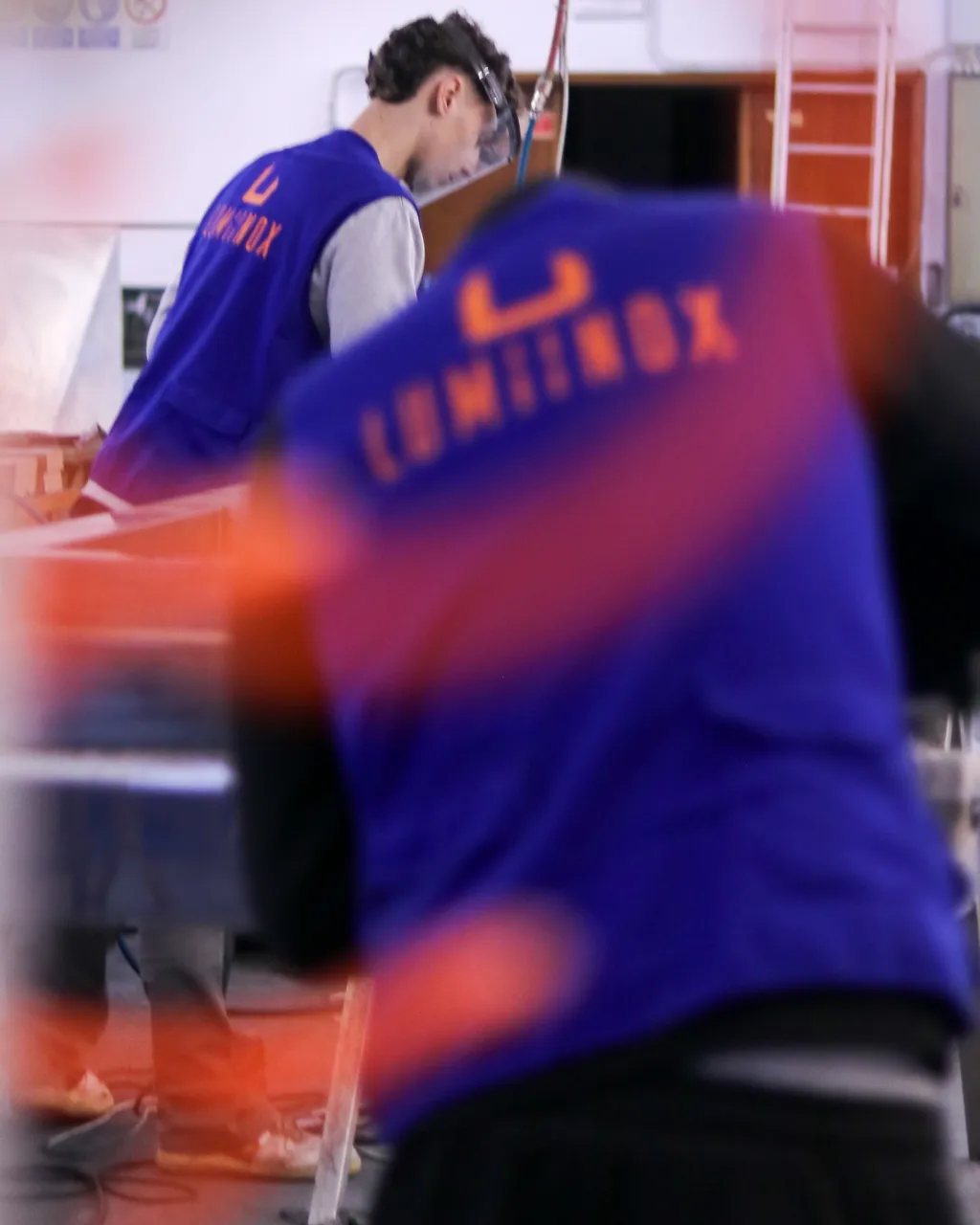
Our equipment: MAQFORT AP 30/125 T
To ensure maximum reliability in the bending process, Lumiinox uses the hydraulic press brake MAQFORT AP 30/125 T, a robust and precise piece of equipment designed for sheet metal forming operations.
Technical capabilities of our press brake:
Bending force of 30 tons · Working capacity up to 1250 mm · Knife-type punch and fractional die · Flexibility for different types of parts · Various bending angles · Precise control of the hydraulic system
The knife-type punch and fractional die assembly provides significant flexibility: it allows bending parts with close flanges, boxes with four folds, and geometries that a continuous tool could not. Thanks to the stability of the structure and the control of the hydraulic system, each bend is the same as the previous one, piece after piece.
Bending types: air, bottom, and coining
Not all bends are made in the same way. In the air bendingmethod, the most commonly used, the punch descends only enough to form the angle, without crushing the sheet against the die: it is fast, versatile, and allows you to obtain various angles with the same tool, controlling the depth of descent. In the bottom bendingmethod, the punch takes the sheet to the bottom of the die, resulting in more stable angles and more defined radii, at the cost of more force. In the coiningmethod, used in specific cases, the material is compressed with much greater force, practically eliminating springback.
The choice of method depends on the material, thickness, required precision, and quantity of parts. It is part of the study that our team conducts before each job, and it is transparent to the client: what matters is that the final part meets the design.
Elastic return and the art of compensating
When the punch force is removed, the metal recovers slightly, opening the angle a few degrees: this is called springback. Each material has its own behavior: stainless steel recovers more than mild steel, aluminium varies according to the alloy and temper. Bending well means anticipating this return, closing the angle to the exact measure so that, when relieved, the part is precisely at the required degrees.
This is where the experience accumulated in thousands of bends becomes irreplaceable. The parameters recorded from previous work, the knowledge of sheet suppliers, and the operator's sensitivity are converted into parts that hit the first time, without wasting material on attempts.
Materials we work with
At Lumiinox we regularly work with Stainless steel and Aluminium, in addition to other metal alloys evaluated on a case-by-case basis. These are materials with different behaviors in bending: stainless steel is more resistant and requires more force, but maintains the bend with great stability; Aluminium bends easily, but requires more generous radii in certain alloys to avoid cracking. Knowing these differences is part of the job, which is why the team's experience is as important as the machine.
Where bending is present
Look around and you'll find bends everywhere. In Technical parts metal equipment and structures. In Industrial components bent sheet metal, from electrical boxes to machine guards. In Construction and architectural elementsflashing, capping, technical baseboards and cladding. In Custom metal profiles that are not in catalogs. In Furniture and decorative elements metal, where the bend shapes the piece itself. And in countless Technical or custom projects arriving at our workshop.
Do you have a part to bend? Talk to us
Quick response | Free and no-obligation quote
From drawing to bent part
Production can start from technical drawings or CAD files. The process begins with flattening: calculating the unfolded part, with compensations for each bend, so that after bending it has the exact measurements of the project. This is followed by laser cutting flattening, with the bend lines marked when useful, and finally the bending, bend by bend, in the studied sequence.
The sequence matters: in a box with four flaps, bending in the wrong order can make the last bend impossible, because the part no longer fits in the machine. Studying the sequence before cutting is another detail that makes the difference between an experienced workshop and trial and error.
Design advice for bent parts
If you design your own parts, some precautions will prevent surprises. Keep the Flanges with sufficient height: a very short flange has no support in the die and comes out imperfect; as a reference, consider at least four times the thickness of the sheet. Keep Holes and cutouts of the bend lines: when they are too close together, they deform during bending; if you need them flush with the bend, let us know, as there are solutions, such as laser-cut reliefs. Prefer Internal radii close to the thickness of the material, which are the most natural for the tool and the metal.
And remember the sequence: parts with many bends in different directions may have physical limitations. Sending us the drawing of the final part allows us to validate all of this before cutting, when changes are still free.
Cutting and bending together: the advantage of a partner
When cutting and bending take place in different workshops, tolerances add up and deadlines also increase. At Lumiinox, the same drawing serves both operations: the cutter knows how the part will be bent, and the bender trusts the cut measurements. The client delivers the project and receives the finished part.
This integrated flow is especially valuable for industrial companies those who regularly need technical components, for metalworking shops and production partners those who subcontract sheet metal transformation, for architects and designers those with custom metal projects, and for private clients those who want bespoke solutions.
Quality found in every bend
Each project has its own needs, and that's why we offer a flexible bending service adapted to different types of clients. The parts are checked throughout the process: angles with a square and goniometer, measurements with calipers, and the first piece of each series serves as a standard for the following ones. At Lumiinox, we combine modern industrial equipment, experience in stainless steel and aluminium metalwork, and a strong commitment to quality.
Our goal is simple: to produce well-executed parts with precision, efficiency, and reliability, from the flat sheet to the final shaping.
From the workshop to the construction site
Many bent parts still go to welding, finishing, and installation. As a complete metalworking shop, Lumiinox accompanies this entire process: the bent box receives welded reinforcements, the bent cladding is installed on-site, and the custom profile arrives assembled in place. For the client, it's the difference between managing four suppliers and having a single partner responsible from design to final result, with over two decades of experience in stainless steel and welded aluminium supporting every decision.
Frequently asked questions
What is the maximum bending length?
Our press brake handles parts up to 1250 mm in bending length, with a force of 30 tons.
Do they bend parts that I've already cut?
Yes, we evaluate parts supplied by the client. Ideally, however, cutting and bending should be integrated from the design stage, because correct planning ensures the final measurements.
What information do they need to quote?
The drawing of the final part with angles and measurements, material and thickness, and quantity. With a DXF, DWG or PDF file, the quote is even faster.
Do you make prototypes?
Yes. We bend unique pieces, prototypes, and pre-series, and keep the parameters for the next production.
Request a quote
Learn more about Lumiinox sheet metal bending service, see what we do on the page of projects and send us your drawing.
We shape your parts with precise bends
Quick response | Free and no-obligation quote